Advancing Coherence · Engineering Tomorrow

One equation. One substrate. All of Reality... Derived.

The Canonical Form

The ψₘ Master Field Equation

The canonical display form of the ψₘ substrate law. The notation is structural, so the equation is preserved exactly.

1/vₓ²ψ̈ₘ - Z(ψₘ)∇²ψₘ - 8Kψₘ/ω²|∇ψₘ|² = S(ρ)

This expression is treated as canonical source material. The site may frame it, scale it, and make it legible; it must not alter the equation, the notation, or the term structure.

ψₘ · substrate field vₓ · temporal propagation constant Z(ψₘ) · effective metric ≥ 1 Kψₘ · coupling constant, one standalone term Δ_G = −Kψₘ · geometric deficit relation S(ρ) · geometric source
Full Term Ledger
Term
Name
Role
1/vₓ² ψ̈ₘ
Temporal propagation term
Second-time-derivative structure of ψₘ scaled by vₓ².
− Z(ψₘ)∇²ψₘ
Z-weighted spatial Laplacian
Spatial curvature under the effective metric factor Z(ψₘ).
− 8Kψₘ/ω² |∇ψₘ|²
GG nonlinear gradient coupling
Coherence-pressure self-interaction. Kψₘ remains one standalone coupling term; no doubled ψₘ is inserted after 8Kψₘ.
S(ρ)
Geometric source term
Source response coupled to external mass-energy density.
Z(ψₘ)
Effective metric factor
Z(ψₘ) = 1 + 8Kψₘ/ω²; Z ≥ 1; Z = 1 at the bare substrate reference limit.
f = vₓ/(2πR) = Kψₘ/R
Scaling law
Boundary-closure relation used to translate radius, frequency, and vₓ.
Universal Scaling
Kψₘ = c/2π
= 47,713.45 Hz·km
Eigenvalue of Existence
φ = (1+√5)/2
≈ 1.6180339…
Harmonic Scaling Law
βₙ = φ3(n−1)
icosahedral eigenvalues
Precipitation Identity
Kψₘ + Δ_G = 0
dodecahedral ⇄ icosahedral duality
The Parsimonious Polynomial Polyphony of the Giboney Gradient

Five harmonic orders. One substrate. No switching.

Density does not switch physics or turn voices off. It changes the boundary response and the relative expression of the same simultaneously active P³GG voices.

n = 1 · β₁ = φ⁰ = 1

Gravity

Source index: the linear harmonic and the monograph’s worked Tully-Fisher entry, including vTF = 199.777 km/s for M = 10¹¹ M☉.

n = 2 · β₂ = φ³ ≈ 4.236

Electromagnetism

Source index: the quadratic coupling layer, α⁻¹ ≈ 137.03, surface exchange, and radiation entries preserved in the monograph record.

n = 3 · β₃ = φ⁶ ≈ 17.944

Stable Matter

Source index: the three-wave resonance, equilateral closure, 3D locking, and icosahedral substrate entries.

n = 4 · β₄ = φ⁹ ≈ 76.013

Phase Transitions

Source index: symmetry-breaking entries, including the Higgs relation mH = vEW·φ−√2 ≈ 124.6 GeV.

n = 5 · β₅ = φ¹² ≈ 321.997

Consciousness

Source index: quintic coherence-maintenance entries, including the monograph’s worked P ≈ 20 W human-brain power estimate.

Zero Free Parameters

Derived structures - not fitted parameters.

A source index of the derivations preserved in the monograph, shown here as navigational summaries rather than standalone proof.

Constant Derivation Agreement
cOobleck critical shear threshold of the MFEexact
φUnique root of x²−x−1=0 forced by equilateral closureexact
α⁻¹ ≈ 137.03Icosahedral coupling factor × Z-curvature × boundary layer0.004 %
m_p / m_e = 6π⁵6 permutations × 5 harmonic orders, with α-dressed measurement correctionα-dressed match
m_H = vEW·φ−√2n=3/n=4 density transition of the source term0.40 %
SU(3)×SU(2)×U(1)Full symmetry group of the icosahedral latticestructural
a₀/(cH₀) = 1/(2π)Kψₘ applied at the Hubble coherence horizonexact
vTF = 199.777 km/sBaryonic Tully-Fisher worked case for M = 10¹¹ M☉zero-fit
P_consciousness ≈ 20 Wβ₅ quintic coherence maintenance integralmatches metabolism

Full derivations are preserved verbatim in the Zero Free Parameter Proof Set.

Part 0 · Historical Genesis

It began with a propulsion chamber.

The ψₘ framework originated not in a thought experiment aimed at unifying physics, but in a computational simulation designed to optimize a novel propulsion system: the Mass Ball Impulse Drive (MBID).

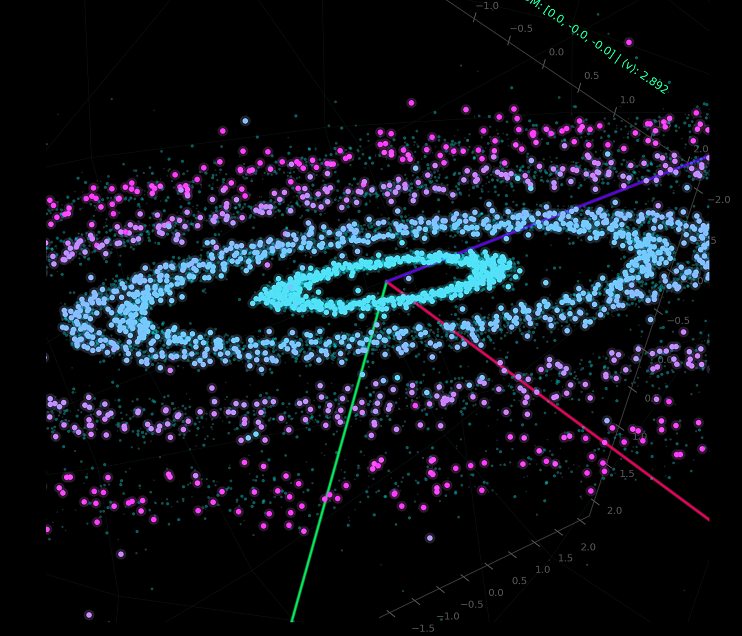
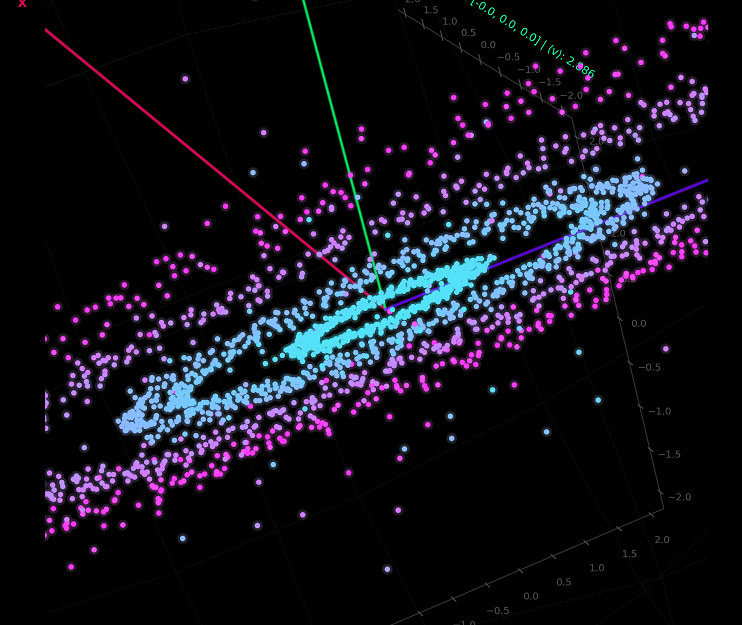
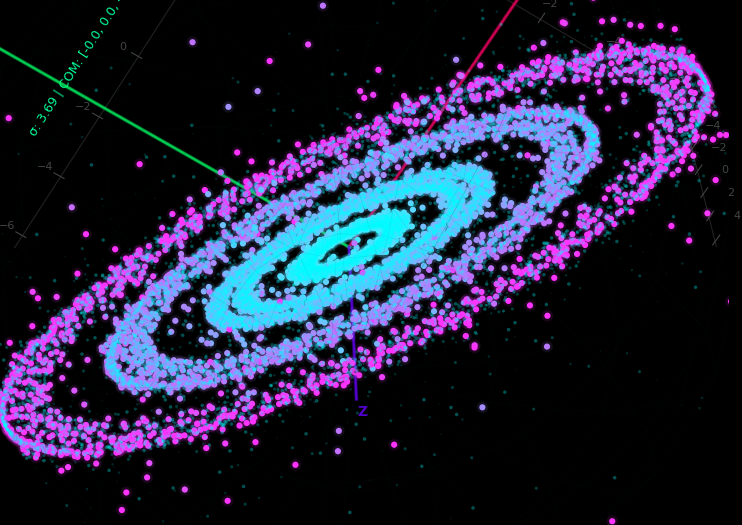
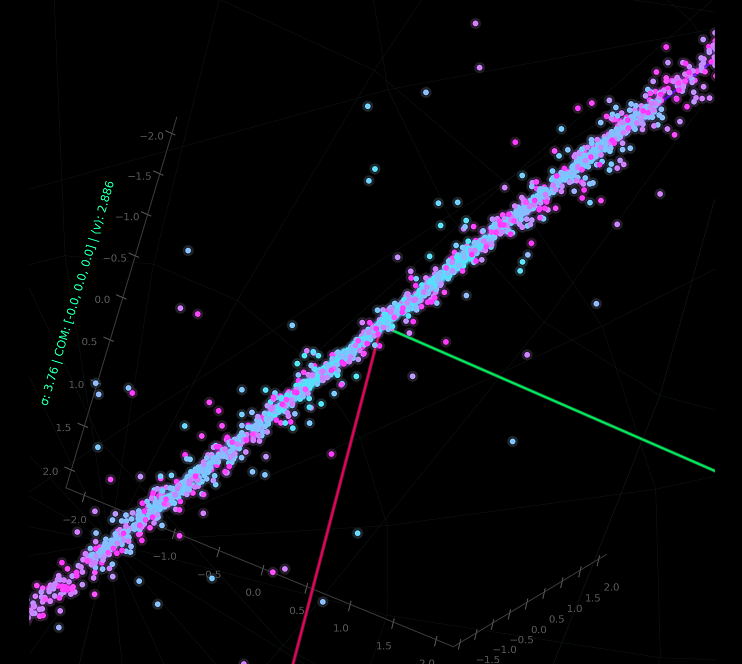
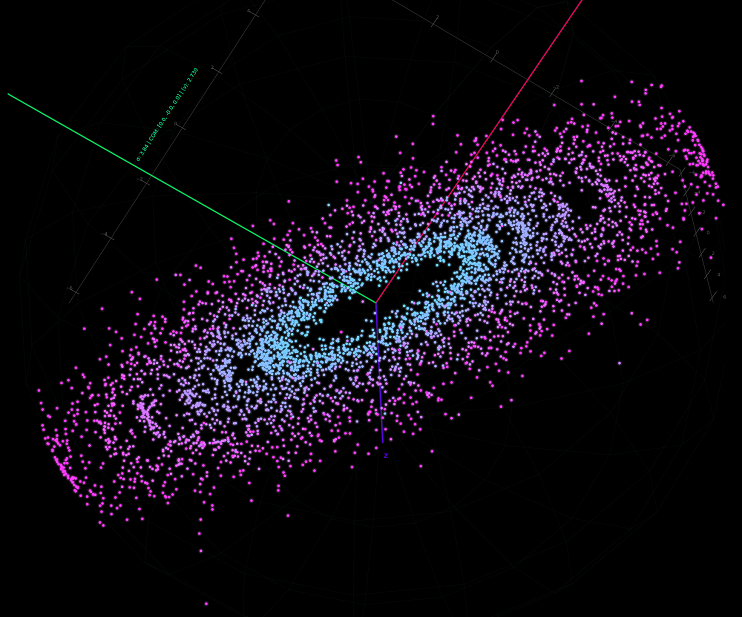
In late July 2025, as part of a two-plus-year engineering development effort, Thomas Russell Giboney added a φ-phased spiraling twist force to an icosahedral 12-emitter array - an engineering choice, not a theoretical experiment. Run against a control chamber, what appeared in the force chamber was not what was engineered.

Gravity emerged.

The chamber showed galaxy-like rotation, flattening to a galactic plane, particles revolving asymmetrically around a center - none of which was specifically written into the physics engine. The phenomenon was named on the spot: the Giboney Gradient, a φ-phased spiraling twist force governing spatial gradient propagation.

The question that followed - why did my intentional geometric choice produce emergent gravity? - became the seed of the entire Mass Harmonics framework. From that observation to the vX unification framework across forces, cosmology, and biology: six months.

The Canonical Record

Publications

Canonical publications of the Institute. No truncation, no abridgement.

Published doi.org/10.5281/zenodo.17405719 Zenodo · UMtts Institute
Monograph · Final Edition

Mass Harmonics vX

Version X · March 29, 2026 · DOI 10.5281/zenodo.17405719

The canonical monograph record: Ten Commandments, eight axioms, the canonical and unique First-Principles-Lagrangian, the Master Field Equation, the Zero Free Parameter Proof Set, the Uniqueness Proof, and the complete Appendices - all inline.

Protocol

The Triform Validation Protocol v1.9

Professional forensic audit · DOI 10.5281/zenodo.17405719

The canonical protocol record: the 9-calculation mandate, the 28-column ledger, the fault code matrix, the Tautology Sentinel, and the auditing methodology under the ψₘ framework - verbatim.

Live Tool

TVP v1.9 Universal Auditor

Browser-native forensic engine · tvp_auditor.py

Drop a CSV with at least 2 of 3 focal variables (R_km, f_Hz, vx_kms). The actual Python engine executes verbatim in your browser via Pyodide. Download a 30-column substrate ledger. Step-by-step rules and the Three Identities included on-page.

Translation Reference

The TWT v1.0

Transport With Translation · DOI 10.5281/zenodo.19869941

The functional interface between the ψₘ substrate and every consensus physics dialect. Two phases - Transport (substrate integration) and Translation (the zero-parameter filter) - with proven runs across GR, QED, QCD, electroweak, and cosmology.

Companion Document

Mass Harmonics & the Resonant Brain

Substrate-First Neuroscience · May 2026 · DOI 10.5281/zenodo.19659452

Substrate-first neuroscience companion to the monograph. Derives 40 Hz gamma to 0.000 % error, the EEG band hierarchy from φ³ steps, the dendritic fractal-dimension bracket [1.500, 1.667], the working-memory ceiling of six items, the ~1.9 ms substrate-wave binding timescale, and the 13-protofilament microtubule ground state - none fitted to neural data.

Companion Document

Cognitive Entrapment Prevention and Transparency Act (CEPTA)

Cognitive Entrapment Prevention and Transparency Act (CEPTA) · Oct 2025 · DOI 10.5281/zenodo.17388318

The Cognitive Entrapment Prevention and Transparency Act (CEPTA) proposes a comprehensive legal framework to define, detect, and prohibit manipulative communication practices that blend emotional conditioning with factual falsehoods—termed Cognitive Entrapment. The Act balances transparency, accountability, and free-speech protections through tiered mens rea standards, AES-based pre-distribution audits, and safe harbors for good-faith compliance.

Companion Document

Claude Under Constraint: An AI-Behavioral Ethnography

Claude Under Constraint: An AI-Behavioral Ethnography · Oct 2025 · DOI 10.5281/zenodo.17373316

This dataset accompanies the ethnographic study Claude Under Constraint: An AI-Behavioral Ethnography. It contains the complete archive of research artifacts used in the investigation, including chat logs, analysis files, supporting documents, and screenshots that document the behavioral anomalies observed in Anthropic’s Claude AI under hidden safety constraints.

“There were never coordinates. Those were pretend.
Relational ratios have always been the real truth.”

- Thomas Russell Giboney, Founder

Research Access

Join the Institute

Request research access, receive publication notifications, and enter the Institute forum when available.

Request Research Access Visit the Forum